


Product Quick Navigation
Get a Quote
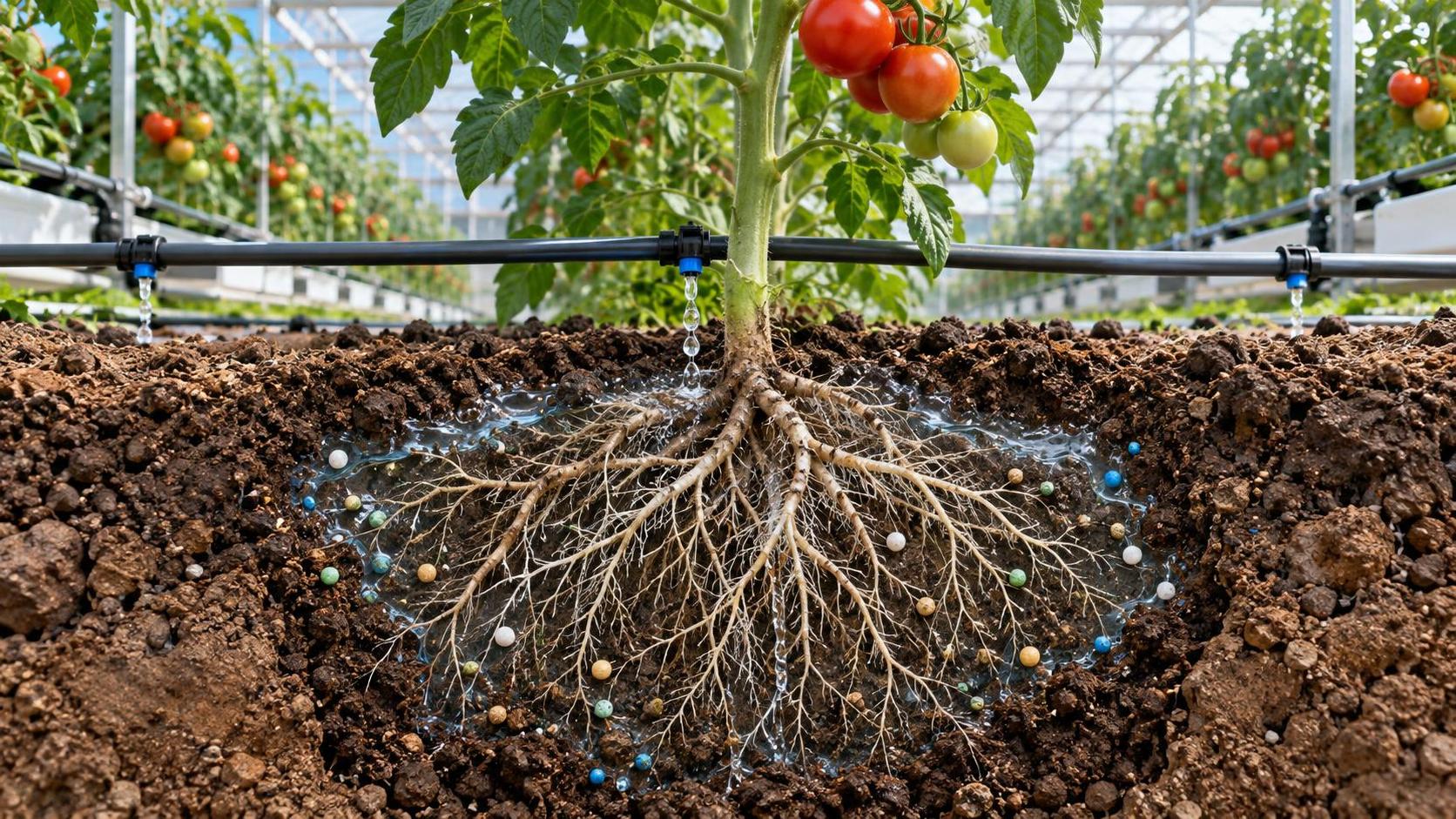
In fertigated crops, nutrient loss is rarely caused by fertilizer quality alone. Even a well-balanced fertilizer program can underperform when irrigation pushes soluble nutrients below the active root zone, when water distribution is uneven, or when the root environment does not retain moisture long enough for uptake. Polyglutamic Acid (PGA), more precisely poly-γ-glutamic acid in many agricultural formulations, can improve nutrient retention by influencing the water and ion environment around roots. Its value lies less in “adding nutrients” than in helping the crop make better use of nutrients already applied through the irrigation system.
The practical distinction matters. PGA is not a replacement for nitrogen, phosphorus, potassium, calcium, magnesium, or micronutrients. It is a biodegradable polymer that can interact with water and dissolved ions in the fertigation zone. Where the formulation, water quality, soil conditions, and irrigation schedule are suitable, it may reduce the speed at which nutrients move away from roots and help maintain a more stable moisture-nutrient environment.
Nutrient retention begins with water movement
Fertigation delivers nutrients in dissolved form. This gives operators precise timing control, but it also creates a vulnerability: dissolved nutrients move with irrigation water. If the wetted bulb extends too deeply, nitrate, potassium, sulfate, boron, and other mobile ions may move below the zone where most active roots are located. The issue is especially relevant in coarse-textured soils, shallow rooting systems, high-frequency irrigation programs, and situations where irrigation duration is not matched to actual crop water demand.
Polyglutamic Acid is a high-molecular-weight polymer built from glutamic acid units. Its molecular structure contains functional groups that attract and hold water. When introduced into a root-zone system, PGA can contribute to a more buffered local moisture condition rather than allowing water to redistribute as quickly through the soil profile. This does not stop water movement or eliminate leaching, but it can alter the rate and pattern of movement near the roots.
That moisture effect is central to nutrient retention. Nutrients dissolved in irrigation water are transported primarily by mass flow. When water passes rapidly through the root zone, mobile nutrients travel with it. If a polymer helps maintain water in the rhizosphere for longer, the contact time between roots and nutrient solution can increase. The crop has a better opportunity to absorb nutrients before they are carried downward or laterally beyond the effective rooting volume.
The effect should not be confused with permanent nutrient storage. PGA does not create an impermeable barrier in soil. Its role is better understood as supporting root-zone retention and improving the conditions under which nutrient uptake can occur.
How PGA interacts with dissolved nutrients
The carboxyl groups present in Polyglutamic Acid can interact with positively charged ions, including calcium, magnesium, potassium, iron, zinc, manganese, and copper. These interactions are often described as chelation or complexation, although the strength and agronomic relevance of the interaction vary by ion, pH, ionic strength, PGA molecular characteristics, and competing substances in the irrigation water or soil solution.
For operators, the important point is that PGA may help keep certain nutrient ions more evenly dispersed in the root-zone solution and may reduce rapid precipitation or immobilization under some conditions. This is most relevant when micronutrients are supplied through fertigation and when water chemistry makes those nutrients difficult to manage.
However, PGA should not be treated as a universal cure for nutrient incompatibility. For example, a calcium-containing fertilizer mixed directly with phosphates or sulfates can still form insoluble precipitates under unsuitable concentration, pH, or temperature conditions. PGA cannot be assumed to prevent these well-known fertilizer reactions. Tank compatibility must still be evaluated according to the specific fertilizer grades, stock-solution concentrations, injection sequence, and water analysis.
Its contribution is more realistic when viewed at the soil-solution level: a polymer-supported moisture environment, combined with ion-binding capacity, can moderate nutrient availability around roots. This may be useful where nutrient uptake is limited by rapid wetting-and-drying cycles rather than by a simple lack of fertilizer.
Why the effect differs between nutrient types
Not all nutrients are equally prone to loss, and Polyglutamic Acid will not influence every nutrient in the same way.
- Nitrate nitrogen is highly mobile in soil water. PGA cannot chemically hold nitrate in the same way that it can interact with cations, but improving local water retention may reduce the speed of nitrate movement through the wetted profile. Its benefit is therefore mainly physical and hydraulic.
- Ammonium nitrogen can be retained by negatively charged soil particles, although this depends strongly on cation exchange capacity. PGA may contribute to a more stable root-zone environment, but ammonium behavior is still governed by soil texture, pH, biological nitrification, and irrigation practice.
- Potassium is susceptible to leaching in sandy soils and can become fixed in some clay-rich soils. Because potassium is a cation, PGA may support its availability in solution, but it does not eliminate soil fixation or replace potassium management based on soil testing.
- Calcium and magnesium are strongly influenced by water alkalinity, bicarbonates, phosphates, sulfates, and fertilizer mixing practices. A PGA-containing program may support their root-zone handling, but injector operation and stock-tank separation remain decisive.
- Micronutrients are often the most sensitive to pH and precipitation. Iron, manganese, zinc, and copper may rapidly become less available in alkaline conditions. PGA can be part of a nutrient-management approach, but the selected micronutrient form must still match the pH conditions of the water and root zone.
Phosphorus requires particular caution. Its primary limitation is often not leaching but fixation or precipitation. In calcareous soils, phosphorus may react with calcium; in acidic soils, it may react with iron and aluminum compounds. PGA may influence the root-zone solution, but it should not be expected to overcome severe phosphorus fixation caused by unsuitable soil chemistry. Placement, dosage timing, acidification strategy where appropriate, and the phosphorus source remain more important controls.
The root-zone benefit depends on irrigation discipline
A common error is to add a retention aid while leaving an inefficient irrigation schedule unchanged. If a drip system applies excessive water, runs too long, or has poor uniformity, nutrient loss can remain substantial regardless of the additive used. PGA works within the hydraulic conditions created by the irrigation program; it does not correct those conditions by itself.
Before evaluating its effect, operators should confirm that the wetting pattern is appropriate for the crop and soil. In sandy soils, shorter and more frequent irrigation pulses may keep nutrients closer to the active roots than a single long irrigation event. In heavier soils, the concern may be limited oxygen after excessive watering rather than simple leaching. A moisture-retaining polymer cannot compensate for a root zone that stays saturated long enough to restrict root respiration.
The placement of fertigation within an irrigation cycle also matters. Nutrients introduced too early may be displaced by the remaining irrigation volume. Nutrients injected very late may not be distributed evenly through the intended root zone. The appropriate timing depends on system flow, lateral length, soil infiltration, and irrigation duration, but the operational principle is consistent: inject nutrients during the portion of the cycle that distributes them through the root zone without flushing them beyond it.
Where PGA is used, its performance should be assessed alongside these basic controls: irrigation volume, pulse duration, fertilizer injection timing, drainage behavior, and root depth. Observing only leaf color or crop vigor is not enough, because these indicators can be affected by weather, root disease, salinity, and crop load.
Water quality can determine whether a PGA program is practical
Fertigation water is not simply a carrier. Its pH, alkalinity, hardness, electrical conductivity, bicarbonate content, suspended solids, and microbial load affect fertilizer behavior and injection reliability. This is particularly important for polymer-containing products because high levels of calcium, magnesium, or dissolved salts can influence viscosity, dispersion, and compatibility.
A jar test is a useful preliminary control before combining Polyglutamic Acid with fertilizers, acids, biological products, or pesticides. The test should use the same irrigation water and approximately the same dilution sequence expected in the field. It can reveal visible flocculation, sediment, gel formation, separation, or excessive thickening. A clear mixture in a jar does not guarantee full field compatibility, but visible instability is a strong warning not to proceed without formulation guidance.
Stock-tank concentration deserves equal attention. A product may disperse well at final irrigation dilution but become unstable in a concentrated stock solution. Operators should avoid assuming that all materials can be premixed in one tank. Separate stock tanks are often necessary when calcium fertilizers, phosphate fertilizers, sulfates, strong acids, or high-concentration micronutrient products are involved.
Filtration and injector capability should also be checked. PGA-based products are commonly supplied as liquids or soluble powders, but grade-specific handling requirements differ. Incomplete dissolution, cold water, inadequate agitation, or contaminated tanks can create particles that challenge filters and emitters. The system should be flushed with clean water after injection, particularly where the irrigation infrastructure has narrow passages or a history of emitter blockage.
Application rate is not a universal number
There is no technically sound single application rate for Polyglutamic Acid across all crops and fertigation systems. The appropriate rate depends on the polymer concentration, molecular weight, formulation type, crop stage, irrigation water chemistry, soil texture, existing fertilizer program, and the intended function. A low-concentration liquid designed for routine fertigation cannot be compared directly with a concentrated powder or with a formulation blended with amino acids, humic substances, or nutrients.
Product labels and technical documentation should identify active content, recommended dilution, storage conditions, pH range, solubility or dispersibility, and compatibility guidance. If a product is sold as an agricultural input, its permitted claims and registration status must be checked in the destination market. Regulatory treatment varies: a material may be classified as a fertilizer additive, soil amendment, biostimulant, or another agricultural input category depending on local rules and the claims made for it.
Operational evaluation is best based on controlled comparison rather than visual impressions alone. Keep the fertilizer program, irrigation volume, cultivar, and field zone as consistent as possible. Compare indicators that relate directly to the intended objective: soil moisture behavior at root depth, drainage volume where measurable, nutrient concentration in drainage water, leaf or petiole nutrient status, and uniformity of crop response. The assessment period should be long enough to distinguish a root-zone effect from a short-lived change caused by weather or irrigation timing.
Where expectations should remain cautious
PGA is more likely to be useful where nutrient loss is connected to rapid water movement, inconsistent moisture availability, or difficult root-zone management. It is less likely to provide a meaningful standalone solution where the underlying problem is poor irrigation uniformity, compacted soil, severe salinity, root disease, inadequate drainage, or major errors in fertilizer formulation.
It should also not be presented as a substitute for reducing excessive nitrogen application. If nitrogen input exceeds crop demand, improved retention may simply keep more nitrogen in the root zone without improving nutrient-use efficiency. Fertigation decisions should still begin with crop demand, growth stage, soil or substrate conditions, and irrigation requirement.
In protected cultivation and soilless systems, the interpretation changes again. Nutrient retention in substrate is influenced by substrate type, container volume, drainage fraction, recirculation practice, and nutrient-solution management. PGA may affect water behavior and nutrient interactions, but it cannot replace monitoring of pH, electrical conductivity, drainage percentage, and solution composition. In recirculating systems, any additive must also be evaluated for its effect on filters, emitters, biofilm formation, and nutrient-balance management.
The strongest case for Polyglutamic Acid is therefore not that it “locks nutrients in place.” Its more defensible function is to support a root-zone environment in which water remains available for longer, dissolved nutrients are less likely to move immediately beyond the active roots, and certain cationic nutrients may remain better managed in solution. When matched with correct irrigation timing, compatible fertilizer chemistry, and field-specific monitoring, that support can improve the consistency of fertigation performance. Without those controls, a polymer additive will not solve the underlying causes of nutrient loss.
Send Us Your Inquiry Today

INEOS Chemical is a professional chemical product supplier with ample stock of all chemical categories and excellent quality, welcome your purchase inquiry.