


Product Quick Navigation
Get a Quote
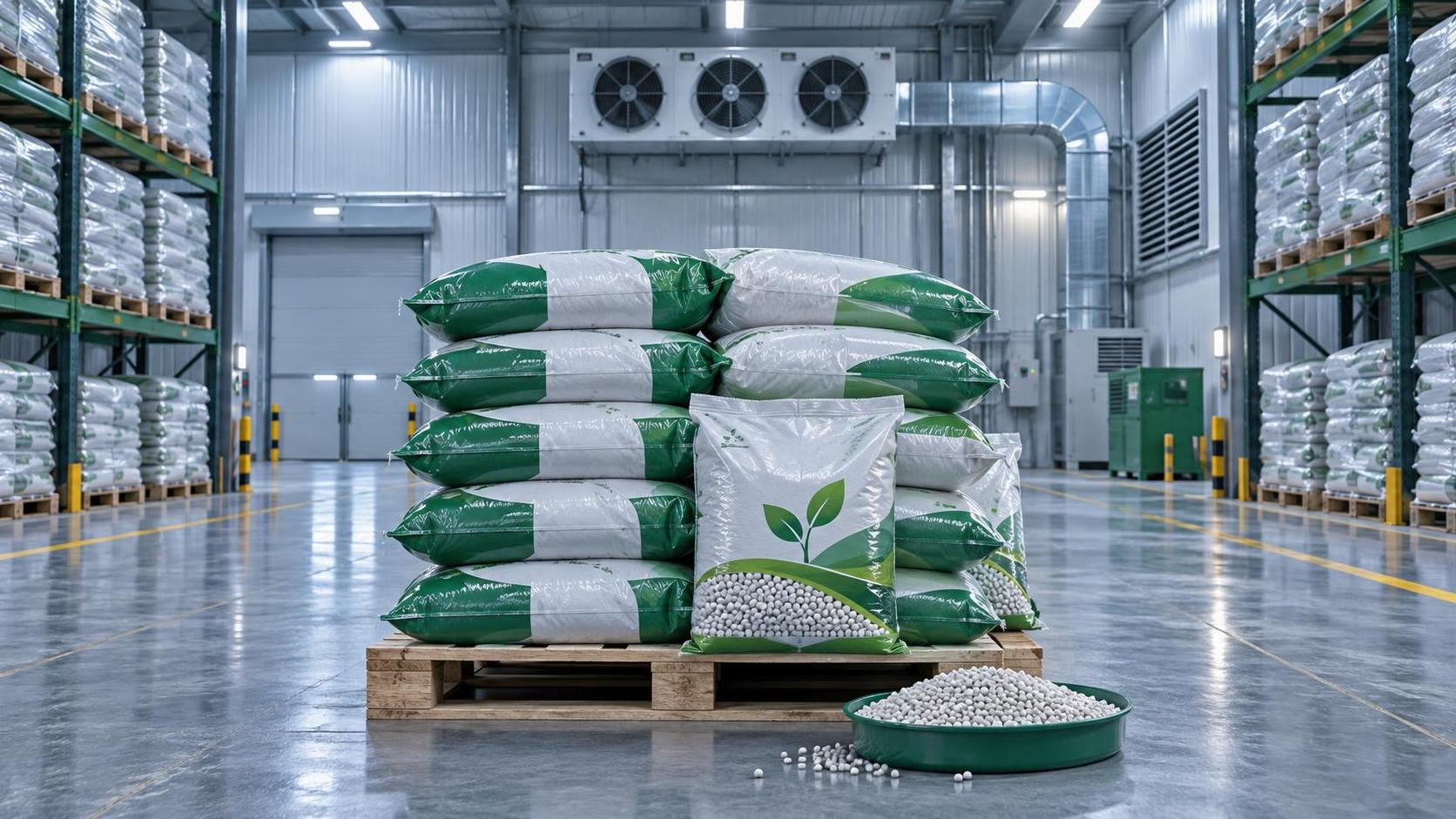
Fertilizer caking is not merely an appearance defect. Once granules or prills lose flowability, weighing becomes less accurate, blending can become non-uniform, mechanical conveying may overload equipment, and manual de-caking can introduce dust exposure and handling hazards. In severe cases, hardened material cannot be discharged from bags, bulk containers, hoppers, or rail and truck compartments without mechanical intervention.
The immediate cause is usually the formation of bonds between particles. Moisture, temperature variation, pressure, product composition, particle condition, and packaging performance determine whether those bonds remain weak and reversible or develop into a dense, solid mass. Effective prevention therefore requires more than keeping a warehouse dry: it requires matching storage controls to the physical and chemical behavior of the specific fertilizer.
How fertilizer particles turn into a solid mass
Most fertilizer caking begins at particle contact points. Granules are not perfectly smooth; they have pores, surface irregularities, fines, and small areas of soluble material. When water is present, even in a thin adsorbed layer, soluble salts can dissolve locally. If conditions later change, the dissolved material recrystallizes where particles touch. These crystals form solid bridges, binding individual granules together.
This mechanism explains why a product can arrive dry, pass a routine moisture check, and still cake after storage. The relevant issue is not only total water content. Surface moisture, moisture migration within a bag, humid air entering through damaged packaging, and condensation caused by temperature cycling can all create local conditions suitable for bridge formation.
Several bonding mechanisms may occur at the same time:
- Liquid bridging: absorbed moisture creates thin liquid films between particles. The material may still break apart easily at this stage, but flowability is already declining.
- Crystallization bridging: dissolved fertilizer salts recrystallize at contact points after drying or cooling. This is a common cause of persistent, hard caking.
- Pressure consolidation: the weight of stacked bags or bulk material increases contact area between particles and strengthens bridges over time.
- Surface softening or phase change: certain materials can soften, partially dissolve, or change crystal form when exposed to unsuitable temperature and humidity conditions.
- Fine-particle binding: dust and fractured granules fill the spaces between larger particles, retain moisture more readily, and create more contact points for agglomeration.
Caking is therefore a time-dependent storage failure. A short exposure to humidity may produce only minor clumping, while the same exposure under stack pressure for several weeks can produce blocks that are difficult to screen or crush without changing particle-size distribution.
Moisture is the main trigger, but relative humidity alone is not enough
Many fertilizers are hygroscopic, meaning they absorb water vapor from air. Their tendency to absorb moisture depends on composition, temperature, particle surface area, and the surrounding humidity. Once air humidity exceeds a product-specific critical level, the fertilizer surface can begin to take up moisture more rapidly. A warehouse that is acceptable for one fertilizer may be unsuitable for another.
Nitrogen fertilizers containing highly soluble salts are particularly sensitive to moisture uptake. Urea, ammonium nitrate-based fertilizers, calcium ammonium nitrate, ammonium sulfate, and many compound NPK products do not behave identically. In blended products, different components may absorb water at different rates. Moisture can migrate from a more hygroscopic component to a less hygroscopic one, creating localized wet zones and uneven caking.
Humidity control should also account for dew point. Condensation often causes more serious damage than a moderately elevated but stable relative humidity. For example, bags stored near an external wall, roof, loading door, or uninsulated metal surface may cool below the dew point during night-time temperature drops. Moist air then condenses on packaging or within the headspace of partially opened packs. The problem may remain invisible until the outer layer of a pallet becomes hard or a bag develops a wet, compacted base.
Opening warehouse doors during humid weather, moving cold fertilizer into warm moist air, and storing product directly on concrete floors are common routes for moisture exposure. Concrete can release or retain moisture, especially where vapor barriers are ineffective or where rainwater has entered the facility. Pallets are not a complete solution if they are damaged, too low, or placed on wet flooring.
Temperature cycling drives hidden moisture migration
Temperature affects caking in two ways. It changes the amount of water that air can hold, and it changes the solubility and physical behavior of fertilizer salts. Repeated warming and cooling can move moisture through a package even when there is no obvious water leak. During warm periods, water vapor may distribute through the headspace and pore spaces. During cooling, vapor can condense at colder particle surfaces.
Daily temperature swings are especially problematic in warehouses with thin roofs, poor insulation, direct solar heating, or inconsistent ventilation. Pallets positioned near loading bays and exterior walls often experience wider temperature variation than stock in the center of the building. A quality inspection based only on one sample from the center of a lot can miss this localized deterioration.
Temperature management is also a safety matter for fertilizers containing ammonium nitrate. Storage controls for ammonium nitrate products must be based on the applicable product safety data sheet, local legal requirements, and site-specific fire and emergency procedures. Caking prevention must never lead to unsafe storage choices, such as enclosing incompatible materials in poorly ventilated areas or using uncontrolled heating methods. Heat sources, combustible contamination, incompatible chemicals, and blocked access routes require separate control even when the immediate concern is product flowability.
Pressure turns minor clumping into hard caking
Stack pressure does not create moisture, but it makes moisture-related bonding more damaging. The lower layers of a tall pallet stack carry the greatest load. In bulk storage, the material near hopper outlets and silo walls may remain under load for extended periods. Fine particles settle into voids, particle contacts become tighter, and weak liquid bridges can develop into durable solid bridges.
Long storage time increases this effect. A fertilizer with acceptable flowability at packing may compact after a prolonged dwell period, particularly if it has experienced moisture or temperature excursions. This is why caking complaints should not be attributed automatically to manufacturing quality or transport damage. The investigation needs to trace the full chain: production, cooling, packaging, loading, sea or land transit, port handling, warehouse storage, and final use.
Stack design should reflect the strength of the bag, pallet stability, product sensitivity, and expected storage duration. Exceeding a package supplier’s recommended stack height can damage seams and liners, while excessive compression can worsen caking even if the bags remain intact. Uneven pallets create concentrated loads that deform lower bags and increase the chance of localized hardening.
Product condition at receipt determines storage tolerance
Storage controls cannot fully compensate for material that was packed too warm, contains excess fines, has inconsistent particle strength, or already shows elevated surface moisture. Incoming quality checks should focus on the indicators that predict handling behavior, not only on chemical nutrient content.
A practical receiving inspection may include:
- verification of packaging integrity, including inner liner condition, seam closure, valve area, and signs of abrasion or puncture;
- inspection for wet spots, free powder, bag deformation, hardened corners, or material adhering to the inner surface;
- measurement or confirmation of product temperature where material has recently been manufactured, transported through hot climates, or exposed to direct sun;
- sampling from more than one location, especially outer pallets, lower pallet layers, and packages near container doors or walls;
- assessment of moisture, particle-size distribution, fines level, and flowability against the agreed product specification;
- review of transport conditions when visible condensation, water staining, or container damage is present.
Sampling must be representative. A single bag may not reveal a pallet-level problem. When a shipment has travelled through changing climate zones, the outside rows and bottom layers deserve specific attention. Material stored in flexible intermediate bulk containers should also be checked for compaction around discharge spouts, where pressure and moisture migration can combine.
Packaging is a moisture-control system, not just a transport container
Fertilizer packaging must resist water ingress, mechanical damage, and vapor transmission for the intended distribution route and storage period. A woven polypropylene outer bag may provide handling strength, but its moisture barrier depends on the liner design and closure quality. Small defects at seams, valves, stitched areas, or heat seals can permit humid air to enter repeatedly during storage.
Packaging selection should consider whether the fertilizer is sold in bags, bulk bags, or bulk form; how long it will remain in the supply chain; whether containerized sea transport is involved; and whether stock may be exposed to humid ports, open loading areas, or non-climate-controlled warehouses. A packaging format that performs adequately for rapid domestic distribution may not provide sufficient protection for a long export route with several handling stages.
Operational controls are equally important. Bags should be protected from rain during loading and unloading, placed on clean dry pallets, and kept clear of walls and floor moisture. Stretch wrap and pallet hoods can reduce exposure to dust and splash water, but they should not be treated as a cure for wet product or defective primary packaging. If water is sealed inside a wrapped pallet, the wrap may retain the problem rather than prevent it.
Warehouse practices that reduce caking risk
The most reliable approach is to control moisture entry, temperature variation, dwell time, and mechanical pressure together. Warehouse conditions should be monitored in the zones where fertilizer is actually stored, rather than relying only on a single office-area humidity reading. Measurements near doors, walls, roof lines, and floor level are often more useful than a central average.
Key controls include keeping roofs, drains, doors, and wall penetrations in good repair; correcting water leaks promptly; separating fertilizer from wet materials and wash-down areas; and preventing forklift damage to bags and pallet wrap. Stock rotation should be based on receipt date, batch traceability, and product sensitivity. First-in, first-out handling reduces dwell time, but it must not override quarantine status or batch segregation requirements.
Where humidity control equipment is used, it should be sized for the building’s air exchange, door-opening frequency, and seasonal moisture load. Dehumidification is most effective in a reasonably sealed area. Running portable units in a warehouse with continuously open loading doors may create a false sense of control while consuming energy without stabilizing conditions.
Bulk storage requires additional attention to silo design, roof sealing, aeration strategy, and discharge geometry. Introducing ambient air without considering its moisture content can worsen caking. Air used for conveying or conditioning should be evaluated for both temperature and humidity, particularly where it contacts hygroscopic materials.
Do not confuse anti-caking treatment with permission for poor storage
Anti-caking agents can reduce particle-to-particle adhesion by modifying surface properties, absorbing limited moisture, or reducing bridge formation. Surface coatings may also improve handling. Their effectiveness depends on correct application, uniform coverage, fertilizer composition, and the conditions after packing. They are not a substitute for dry packaging, controlled storage, or sensible stack management.
A common failure occurs when a coating is judged only by initial flowability. A meaningful evaluation should include retained samples or controlled storage assessment that reflects expected temperature, humidity, and compression conditions. Compatibility matters as well: an additive that performs well on one granulated fertilizer may behave differently on prilled material, a high-nitrogen product, or a multi-component blend.
Reprocessing caked fertilizers by crushing or screening can restore short-term flowability, but it may generate excess fines and change the product’s handling characteristics. If rework is considered, the resulting particle-size distribution, dust generation, coating condition, and conformity to specification should be assessed before release. For products with specific safety or regulatory controls, rework decisions also need to follow the site’s documented procedures.
Investigating a caking incident without stopping at the visible symptom
The useful question is not simply whether the fertilizer caked, but where the conditions enabling caking first appeared. Inspection records should compare affected and unaffected stock by batch, packing date, pallet position, warehouse zone, transit route, packaging type, and storage duration. The pattern often provides the strongest clue.
Hardening limited to bottom bags points toward pressure, floor moisture, or pallet design. Damage concentrated near one wall may indicate condensation or water ingress. Caking across an entire batch can suggest product temperature, moisture, fines, coating, or packaging issues. Localized wet lumps near seams or valves are more consistent with packaging failure. A clear pattern helps prevent broad, costly corrective actions that do not address the actual source.
Fertilizers remain free-flowing when the product, package, warehouse, and handling system work as one control chain. Moisture exclusion is essential, but stable temperature conditions, appropriate stacking, intact barrier packaging, representative inspection, and traceable incident investigation are what prevent a minor humidity event from becoming a quality loss and a workplace handling problem.
Send Us Your Inquiry Today

INEOS Chemical is a professional chemical product supplier with ample stock of all chemical categories and excellent quality, welcome your purchase inquiry.